
Table of Contents
Artificial Intelligence (AI) is no longer a futuristic concept—today, it is a powerful force reshaping industries across Canada. From improving patient care to enabling smarter banking and transforming classrooms, AI is redefining how Canadians live and work. These changes are not just technological shifts—they are shaping the way professionals operate and how future graduates can contribute.
1. Healthcare: Enhancing Care, Efficiency, and Outcomes
a. Automating Administration with AI-Powered Medical Scribes
Canadian healthcare has long struggled with the weight of paperwork and administration. Physicians often spend hours completing documentation, leaving less time for patients. To address this, Canada Health Infoway launched the AI Scribe Program, which automatically generates structured visit notes from patient consultations (Infoway). Calgary-based Ava Industries (Ava EMR) offers an integrated AI suite—including Ava AI for automated note generation and documentation—built directly into its Canadian EMR platform. Ava also partners with Canada Health Infoway’s PrescribeIT® for e-prescribing integration across clinics.
By reducing administrative burdens, these tools make care more efficient while improving the quality of the doctor–patient relationship.
b. Improving Patient Outcomes and Disease Detection
Beyond administration, AI is enhancing Canada’s ability to protect public health. Toronto-based BlueDot is one of the most notable examples, having detected the COVID-19 outbreak days before the World Health Organization’s first alert (Wikipedia – BlueDot). Using AI to analyze vast streams of data, BlueDot can predict disease outbreaks and help governments respond faster, protecting communities across Canada and worldwide.
c. Strengthening Investment and Innovation
AI in healthcare is also being driven by Canada’s Pan-Canadian AI Strategy, which funds collaboration between institutions such as Mila (Quebec), Amii (Alberta), and the Vector Institute (Toronto) (Wikipedia – Vector Institute). These hubs are leading research into clinical AI, diagnostic tools, and equitable applications of technology in healthcare systems.
What this means for students:
Healthcare in Canada is becoming increasingly data-driven, supported by AI tools that enhance efficiency, accuracy, and public safety. Students who study AI can grow into roles that support innovation in healthtech, from designing smarter tools for doctors to developing predictive models that help safeguard entire populations.
2. Finance: Speed, Smarter Insights, and Responsible AI
a. Fraud Detection, Risk Management, and Automation
Financial institutions in Canada are investing heavily in AI to strengthen trust and efficiency. Banks are already using AI-powered fraud detection systems that monitor transactions in real time, catching suspicious activity that human analysts would struggle to spot at scale. Even the Bank of Canada has addressed the role AI could play in boosting national productivity (Wall Street Journal).
This dual impact—greater efficiency but also new complexities—shows how central AI has become to the financial system.
b. Rise of Canadian AI Startups in Finance
Canada is also emerging as a hub for AI-powered fintech. Cohere, based in Toronto, is a global leader in natural language processing (NLP). Its models are already being used by financial services firms worldwide to enhance compliance, risk management, and client communication (Wikipedia – Cohere). Alongside Cohere, a wave of fintech startups across Canada are integrating AI into investment tools, lending, and personal finance platforms, making the sector more agile and customer-focused.
These examples highlight how AI is not just supporting existing banks but driving an entire ecosystem of financial innovation.
What this means for students:
As AI redefines Canadian finance—through fraud detection, compliance, and fintech innovation—students with an understanding of AI can position themselves to succeed in a sector that values accuracy, security, and innovation. With finance embracing AI at every level, those who learn how these systems work can help shape the future of Canada’s economy.
3. Education: Personalized Learning and Institutional Evolution
a. Adaptive Learning Platforms and AI in Canadian Schools
Education is another area being reshaped by AI across Canada. In British Columbia and Nova Scotia, schools are piloting AI-powered curricula that adjust lessons based on each student’s progress (Industry & Business Canada). These adaptive platforms are helping advanced learners move forward more quickly while ensuring that others receive additional support.
In a country as diverse as Canada, where classrooms bring together students from different cultural, linguistic, and academic backgrounds, this personalized approach ensures more equitable outcomes.
b. Efficiency via Automation and AI Feedback
Canadian universities are also beginning to use AI to automate routine processes like grading, timetabling, and feedback. This allows professors to focus on mentorship and research. At the same time, immersive tools like Virti are being used in Canadian medical and professional schools to simulate high-stakes environments such as patient consultations or leadership scenarios (Wikipedia – Virti).
These changes are making higher education more efficient, interactive, and aligned with the demands of modern workplaces.
c. Acceleration and Ethical Considerations
Canada is also leading the way in ensuring AI in education is applied responsibly. The Ethical AI Governance Framework for Adaptive Learning (EAGFAL) provides guidelines on fairness, privacy, and transparency in the use of AI in classrooms (IIARD Journals).
This ensures that innovation in Canadian education doesn’t come at the cost of student trust or inclusivity.
What this means for students:
As Canadian schools and universities adopt adaptive learning platforms, automation, and ethical frameworks, there is growing need for expertise in how AI can be used to improve education. Students who build skills in AI are not just preparing to use these systems as learners—they are preparing to contribute to the future of education in Canada, shaping how knowledge itself is shared and delivered.
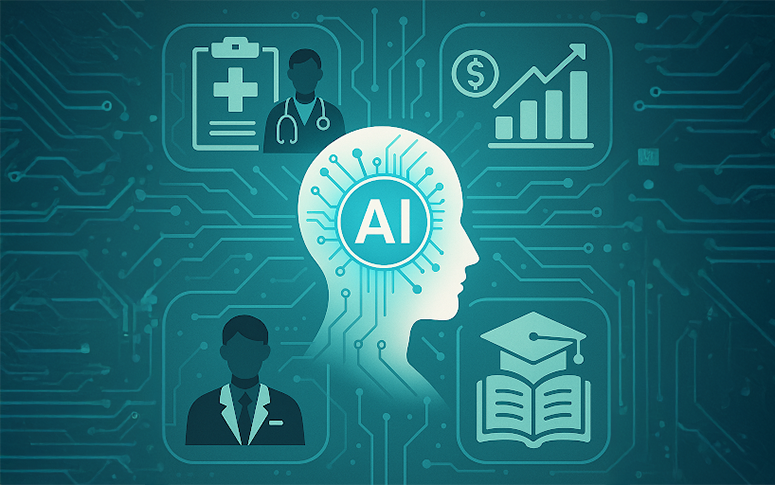
AI is fundamentally reshaping Canadian industries:
- Healthcare is achieving new efficiencies through AI scribes, predictive tools, and health equity research.
- Finance is embracing fraud detection, automation, and fintech innovation to create faster and more secure systems.
- Education is evolving with adaptive platforms, immersive simulations, and strong governance frameworks.
The takeaway is clear: AI is not replacing people—it is amplifying what they can achieve. Across Canada, professionals are working alongside AI systems that make industries smarter, faster, and more adaptive.
For students, the opportunity is immediate. Building a foundation in AI is no longer optional—it is becoming the language of tomorrow’s economy. By developing skills in areas such as data analysis, automation, and ethical AI use, students can position themselves to grow in fields that are already transforming.
At A1 Global College, the AI Diploma program is designed with this future in mind. It equips learners not only with the technical knowledge to understand AI systems but also with the applied skills to use them in real-world contexts—whether in healthcare, finance, or education. In a world where AI is at the center of innovation, learning it now is the first step to leading in Canada’s AI-driven future.
References
- Canada Health Infoway. (2025). AI Scribe Program. Retrieved from https://www.infoway-inforoute.ca/en/featured-initiatives/ai-scribe-program
- Canada Health Infoway. (2025). AI Scribe Program. https://aiscribe.infoway-inforoute.ca/
- Ava Industries. (2025). Ava AI – Beyond Just an AI Scribe. https://www.avaindustries.ca/ava-ai
- BlueDot. (2025). AI for disease surveillance. Retrieved from https://en.wikipedia.org/wiki/BlueDot
- Vector Institute. (2025). Pan-Canadian AI Strategy research hub. Retrieved from https://en.wikipedia.org/wiki/Vector_Institute_(Canada)
- Wall Street Journal. (2025). AI threatens to complicate inflation-taming tasks, says Bank of Canada Gov. Macklem. Retrieved from https://www.wsj.com/articles/ai-threatens-to-complicate-inflation-taming-tasks-bank-of-canada-gov-macklem-says-305eba95
- Cohere. (2025). Natural language processing company. Retrieved from https://en.wikipedia.org/wiki/Cohere
- Industry & Business Canada. (2025). How Canadian schools are transforming education with AI programs that work. Retrieved from https://www.industryandbusiness.ca/how-canadian-schools-are-transforming-education-with-ai-programs-that-work/
- Virti. (2025). Immersive training platform. Retrieved from https://en.wikipedia.org/wiki/Virti
- IIARD Journals. (2025). The Governance of AI in Education: Developing Ethical Policy Frameworks for Adaptive Learning Technologies. Retrieved from https://www.iiardjournals.org/abstract.php?id=58910&j=IJASMT&pn=The+Governance+of+AI+in+Education%3A+Developing+Ethical
+Policy+Frameworks+for+Adaptive+Learning+Technologies